Compliance and risk management
Basic policy on controlling interests
-
(1) Basic policy on party controlling decisions related to Company financial and business policy
-
1. Group fundamental approach to business management
The core of our Group operations involves providing infrastructure deeply embedded in public society, specifically the railway business and other ground transportation services (hereinafter, "core business"). As a corporation, we have a great responsibility to society.
We can fulfill our social responsibilities through our Group business by ensuring user safety and convenience while continuously providing stable transportation services. To achieve this, it is vital that we engage in management with a long-term perspective that anticipates various changes in the business environment by ensuring safety measures, developing routes, expanding facilities, and developing roadside environments.
As we engage in Group activities, giving maximum consideration to the interests of a wide range of stakeholders, including ensuring harmony with local societies and promoting environmental awareness, is key to fulfilling our responsibilities to our customers, shareholders, business partners, and employees, as well as fulfilling our corporate social responsibilities.
One of the results of our commitment to engaging in business development with a long-term perspective and being considerate of a wide range of shareholders has been the development of a diverse range of businesses. While centered on the railway business, other businesses we operate include transportation business that includes bus and taxi operations, a logistics business, a real estate business, a leisure services business, and a construction business. We strive to secure and increase our corporate value by organically linking our core business with these related businesses.
-
2. Details of basic policy
We believe the party controlling decisions related to company financial and business policy must fully understand the approach outlined in Paragraph 1 above and must strive for the medium- to long-term maximization of corporate value and, subsequently, shareholder common interests.
We believe that the shareholders of a listed company should be determined through free market transactions. Even in the event of large-scale purchase that results in a transfer of corporate ownership, we believe individual shareholders should have the final say in determining whether or not they choose to participate in large-scale purchases.
However, there is the possibility that the large-scale purchase of Company stock or a takeover bid may pose a clear threat to our “corporate value and, subsequently, shareholder common interests,” could “substantially force shareholders to sell their shares,” or “involve a lack of sufficient information sharing or time necessary to make a decision regarding whether or not to accept the purchase offer.” We believe there is a need to ensure our corporate value and shareholder common interests by implementing appropriate measures to protect our shareholders from such large-scale purchase.
-
-
(2) Special initiatives to support realization of basic policy
-
1. Group management philosophy
Based on the above approach, through our daily business activities we aim to contribute to the development of society by achieving healthy business growth while fulfilling our corporate social responsibilities. To this aim, we have outlined the Keisei Group Management Philosophy. This Group philosophy outlines that the Keisei Group strive for the safe and pleasant provision of quality products and services that please our customers while contributing to healthy business growth that contributes to social development. To promote the realization of this philosophy, we also created a Group Action Guidelines that covers five elements: safety, service, growth, corporate ethics, and the environment. Through this Philosophy and Group Action Guidelines, we will work to secure and improve our corporate value.
-
2. Group management plan
Under the aforementioned Group Management Philosophy, we formulate Group long-term and mediumterm management plans to clarify our Group management philosophy and goals.
Our Long-Term Business Plan: D Plan encapsulates our Vision for FY2030 to “contribute to sustainability through community partnerships and by enhancing Narita Airport, the entrance to Japan.” We are steadily working to achieve this Vision through initiatives addressing the six long-term management issues of the fundamental and perennial requirement for “safety and reliability”, our core issue, “community wellbeing”, “tourism”and “airport link”, as well as the underlying supports of “governance”and “talent.”
We formulate Group medium-term management plans every three years to achieve our long-term Vision. The first of these, the D1 Plan (FY2022 to FY2024), targeted a “return from Covid slump to recovery path and laying the organizational foundations for achieving D1Plan.” Under this plan, we captured resurgent airport link demand and strengthened our property rental business, achieving revenue and operating income growth in all three years of the plan. We also created potential for medium- to long-term growth mainly by expanding our transportation capacity and laid the groundwork for more efficient group operations.
The goal of the second three-year plan, D2 Plan (FY2025 to FY2027), is to “build on our new group organization foundations to improve Narita airport access, enhance profitability and resilience to external change and transform our corporate structure to support achievement of long-term vision.” Under this plan, we are working to continue to expand our transportation capacity and services with an eye to Narita airport upgrade, to optimize our business portfolio for the future and to achieve the sustainable development of our business area and the Keisei Electric Railway Group.
-
3. Approach to profit returns
Our railway and other transportation businesses are deeply tied to the public. As such, our basic policy on profit returns is to issue stable and sustainable profit returns based on a consideration of performance as well as the need to ensure the internal retention necessary for future business development and to stabilize and strengthen our business platform.
-
4. Initiatives related to corporate governance
We work to enhance corporate governance by developing positive relations with stakeholders as well as working to build, strengthen, and improve internal control functions and structure. Specifically, to promote rapid and effective business implementation, we enhance internal control functions and apply work authority rules and other regulations to promote efficiency as well as ensure compliance, implement risk management, promote management transparency, and conduct fair information disclosure. Moving forward, we will continue working to strengthen our corporate governance.
Our Company adopts a corporate auditor system and has establish a Board of Directors and an Audit & Supervisory Board, and we have designated an accounting auditor. Our Board of Directors is comprised of 15 auditors, including seven outside directors. Furthermore, we set the term of appointment for each director as one year to promote enhancements to our executive monitoring structure. Our Audit & Supervisory Board is comprised of five members, three of whom are outside auditors. Audit & Supervisory Board members attend Board of Directors’ meetings and other important meetings to audit the status of business execution by directors. Audit & Supervisory Board members also liaise closely with our internal audit department and the accounting auditor to exchange opinions and strengthen coordination in order to increase audit efficacy and efficiency.
-
-
(3) Initiatives to prevent the takeover of Company financial and business policy decisions by an inappropriate as outlined in the fundamental policy
The Company implements appropriate measures to ensure the protection of our corporate value and, subsequently, the common interests of our shareholders, from parties attempting to make large-scale purchases of Company stock. This includes requiring the sufficient provision of information necessary for shareholders to make appropriate judgments, disclosing opinions issued by our Board of Directors, and working to ensure shareholders have the time needed to make appropriate evaluations. Implemented measures are within the scope outlined in relevant laws, including the Financial Instruments and Exchange Act and the Companies Act.
-
(4) Ensuring the initiatives above are aligned with ensuring our corporate value and shareholder common interests, and that initiatives are not designed to protect the position of any Company executives
Initiatives outlined in (2) and (3) to improve corporate value are specific measures designed to continuously maintain and improve our Group corporate value and the common interests of our shareholders. As such, said initiatives must be aligned with basic policies, must not harm the common interests of Company shareholders, and must not be designed to protect the position of any Company executive.
Other Matters Concerning to Corporate Governance System
The status of internal structure related to the timely disclosure of Company information is detailed below.
-
(1) Internal Structure related to Timely Disclosure
The Company outlines "Behavior Standards" to be adhered to by all persons engaged in business activities. Within these Standards, we define the "Timely and appropriate disclosure of business information" to promote awareness regarding the rapid reporting of important information if discovered. For Company subsidiaries, in our Affiliate Management Regulations require the establishment of a rapid reporting system to ensure the timely reporting of important business information.
For important issues that occur at the Company or a subsidiary, we conduct management through disclosure in accordance with Insider Trading Prevention Regulations, which we created based on the Timely Disclosure Regulations. In principle, matters related to business execution overseen by full-time executive officers are disclosed following deliberation at Management Meetings (in principle, held twice per month) and matters critical to business management are disclosed after deliberation at Board of Directors' meetings (in principle, held once per month). We work to proactively disclose information that we determine is not applicable to timely disclosure standards but still constitutes information useful to shareholders and investors.
-
(2) Audits of Internal Systems related to Timely Disclosure
The Internal Audit Department conducts periodic internal audits of the management systems related to our general business activities as well as the status of implementation with the goal of validating, evaluating, and improving internal systems from the perspective of compliance with relevant laws and social norms, and in terms of our fulfilling our corporate social responsibilities.
The results of these internal audits are immediately reported to our Compliance & Risk Management Committee members and reports on the status of audit activities are presented at regular Compliance & Risk Management Committee meetings (held twice per year).
Established on May 19, 2006
Revised on March 25, 2008
Revised on May 1, 2015
Revised on October 1, 2021
Revised on April 1, 2022
Compliance & Risk Management Committee
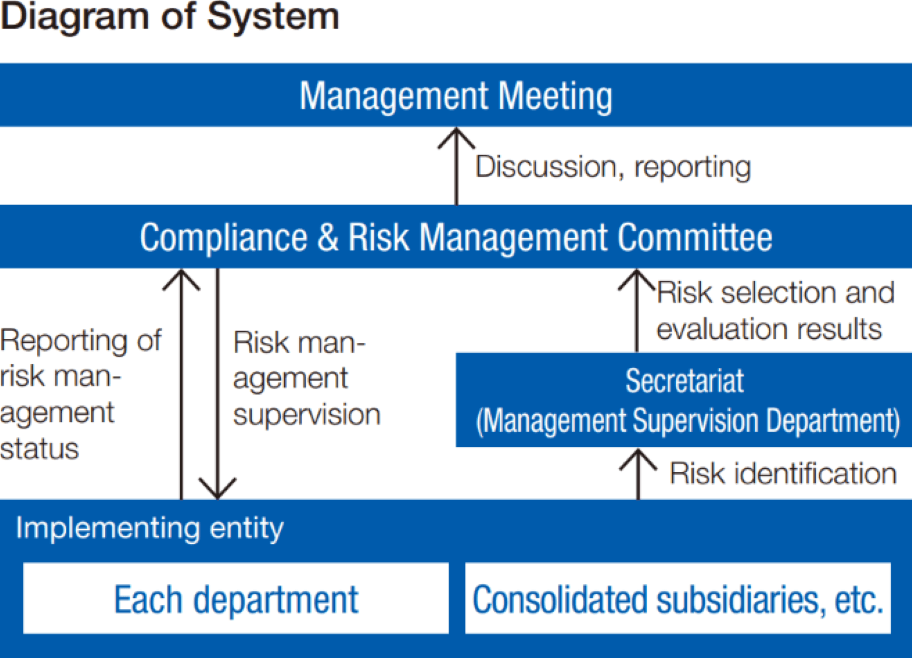
The Compliance & Risk Management Committee aims to ensure the Company and its subsidiaries comply with laws and protect human rights in their operations. It also identifies and evaluates risks that could severely impact business continuity, accurately assesses their effects, and builds a system for appropriate responses, including accident prevention, to support the ongoing development of the Company and its subsidiaries.
Risk management
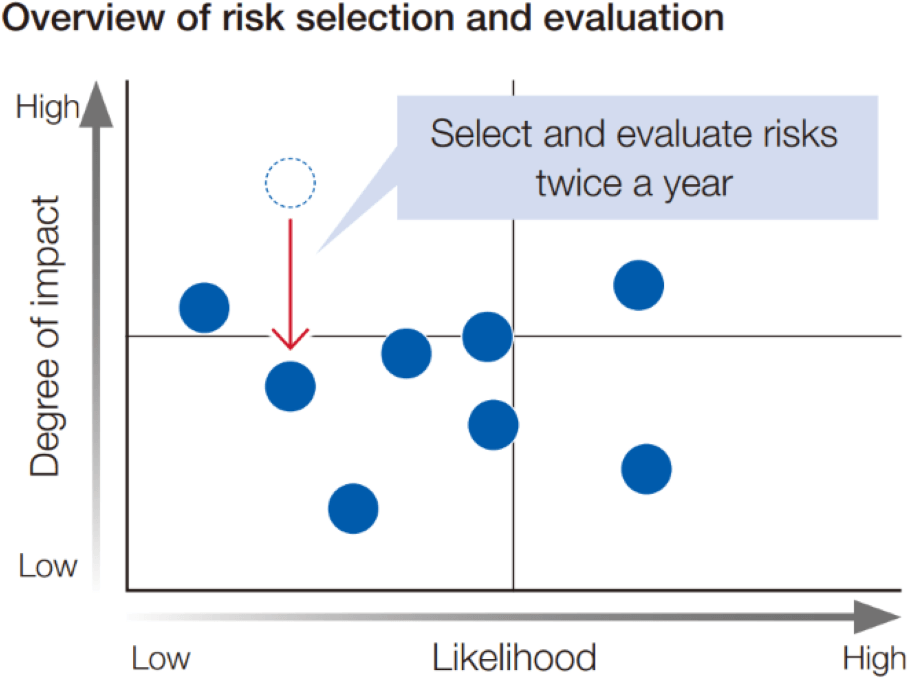
The Compliance & Risk Management Committee has a system in place to systematically identify and evaluate risks that could impact the Group’s overall business continuity, assess their potential effects, and respond appropriately.
Based on the compliance-related risks identified by the Company and its consolidated subsidiaries, we evaluate their respective likelihood and potential impact on sales, and report these findings in Management Meetings.